
how to arrange books on shelf aesthetically usually comes down to one thing: making the shelf feel intentional instead of accidental, even when you have a mix of sizes, colors, and “I’ll read it someday” piles.
If your shelves look busy, it’s rarely because you own “too many” books. More often it’s a layout problem, no visual breaks, no hierarchy, and no plan for the awkward stuff like paperbacks, oversized art books, and random objects that don’t belong anywhere else.
This guide walks you through practical layouts that look good in real American homes, how to choose a style that matches your room, and a few quick fixes that make even a mismatched collection feel curated.
Pick the look first: “library,” “minimal,” or “collected”
Before you start moving spines around, decide what you want the shelf to communicate. This sounds like fluff, but it prevents that endless rearranging where nothing feels right.
- Library look: mostly upright books, tight rows, very little decor, classic and cozy.
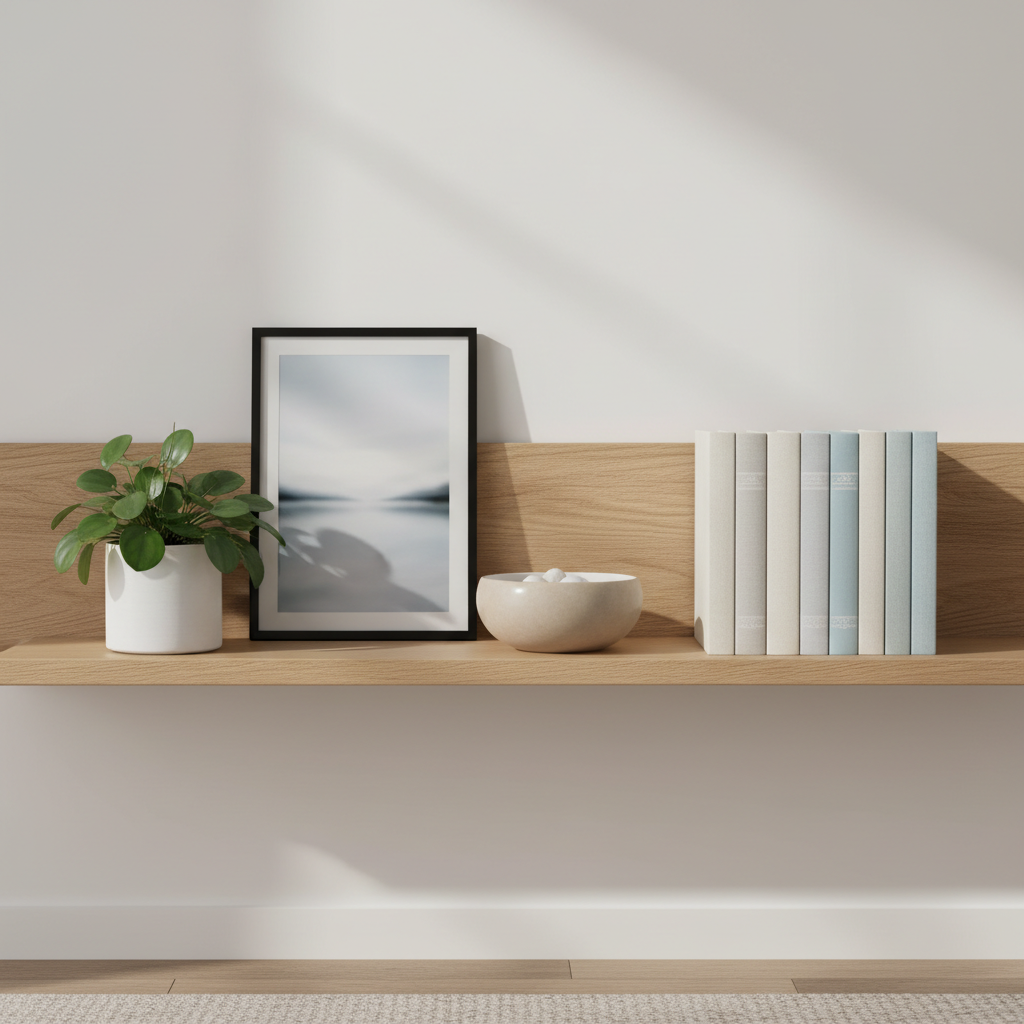
- Minimal look: fewer books on display, more negative space, small decor moments, calm and airy.
- Collected look: mixed orientations, curated objects, some empty space, styled but personal.
Most people land in “collected,” because it works with everyday life and doesn’t require a perfectly matching book set.
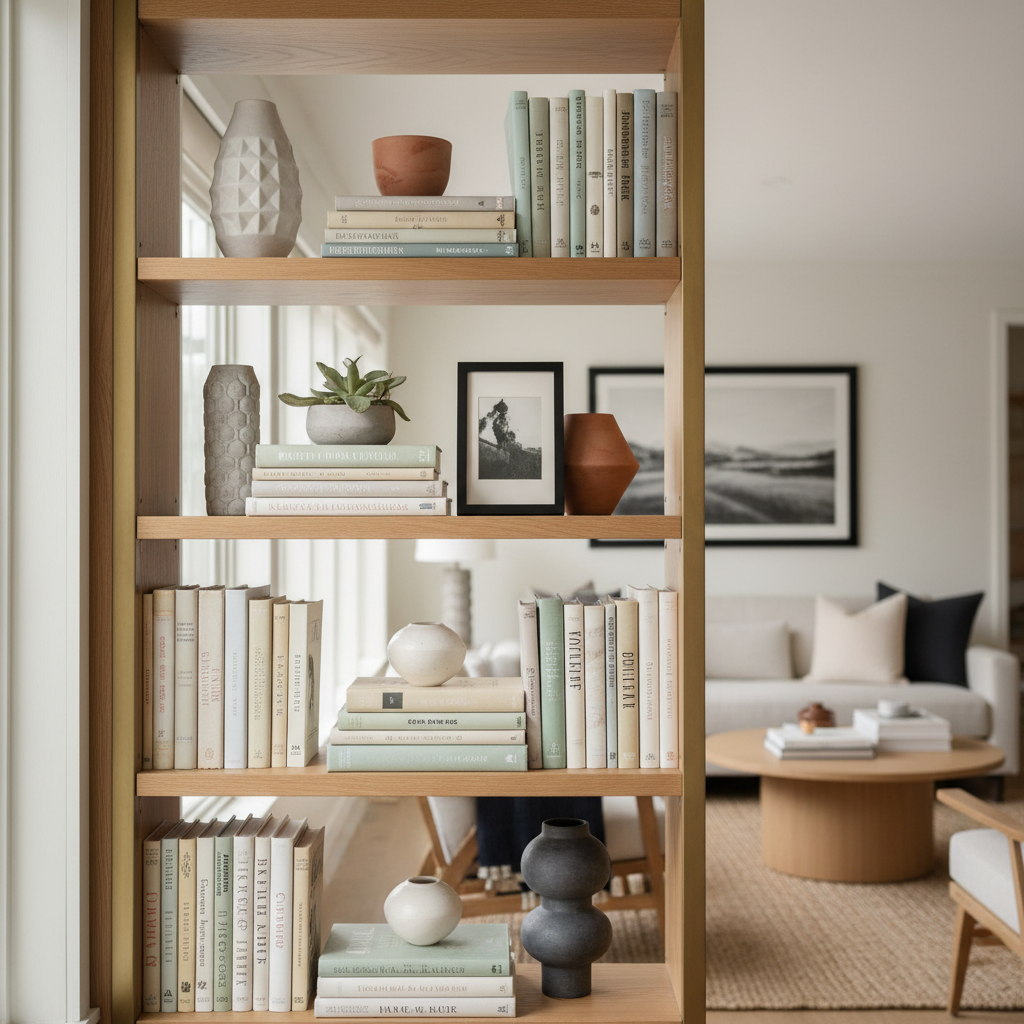
A quick diagnosis: why shelves look “messy” even when they’re clean
When a shelf feels chaotic, it’s usually one of these issues, and the fix is simpler than buying new baskets.
- No breathing room: every inch is filled, so the eye can’t rest.
- Too many heights in one row: tall hardcovers next to tiny paperbacks without any transition.
- All spines, no breaks: one long wall of text becomes visual noise.
- Decor scattered like confetti: lots of small objects instead of a few intentional groupings.
- Color fights the room: bright spines can clash with a calm space, or vice versa.
One more reality check: if you use the shelf daily, “perfectly styled” rarely stays perfect. The goal is a setup that looks good even after normal use.
The 10-minute sorting method (without overthinking)
If you want a shelf that looks designed, you need categories, but you don’t need a spreadsheet. This is the fastest way to get control.
Step 1: Pull everything off (or at least one shelf at a time)
Clearing a single shelf is enough if you’re short on time. Wipe the surface, then rebuild with intention.
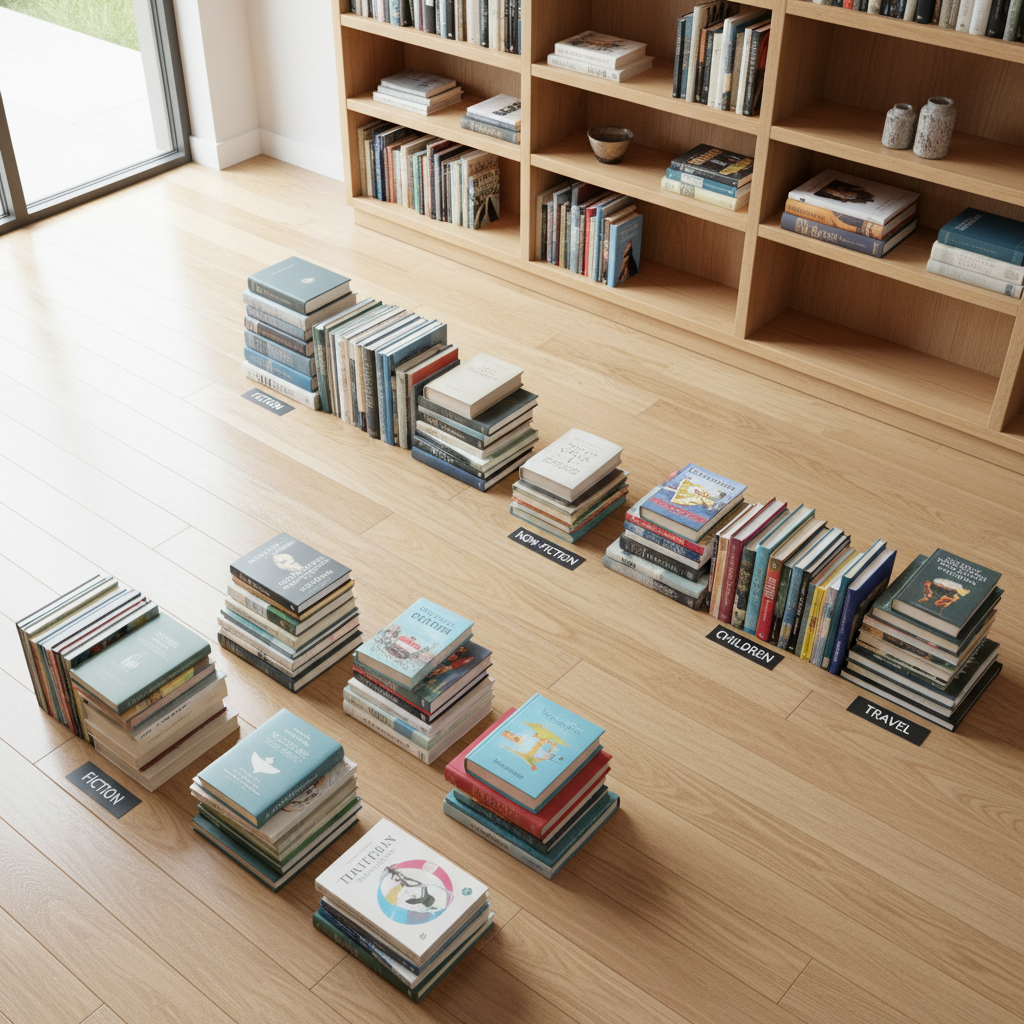
Step 2: Sort into 4 piles
- Keep + display: books you love, beautiful covers, current reads.
- Keep + store: books you want but don’t need to see every day.
- Donate/sell: duplicates, old textbooks, “why do I own this.”
- Elsewhere: manuals, paperwork, kid clutter that migrated.
Step 3: Create “anchors”
Anchors are the big, stable pieces that make a shelf feel grounded: a few tall hardcovers, a couple of horizontal stacks, and 1–2 larger decor items. Build around those, not the other way around.
Go-to layout formulas that look good in most homes
If you’ve ever searched how to arrange books on shelf aesthetically and felt overwhelmed by “rules,” use formulas instead. Pick one, apply it across the unit, then tweak.
Formula A: Mostly vertical + 20% horizontal stacks
- Keep most books upright for a clean “library” base.
- Add 1–2 horizontal stacks per shelf to break the rhythm.
- Top each stack with one object or a small plant (not five tiny things).
Formula B: Color blocks, but only in small sections
Full rainbow shelves can look trendy but also loud, especially in calmer rooms. Try color blocking in zones: one shelf or one side of a shelf.
- Group similar tones together (whites/creams, darks, warm reds, cool blues).
- Leave some “neutral” spines between strong colors to avoid harsh transitions.
Formula C: Height steps (great for mismatched collections)
- Arrange books from tall to short within a section, like a gentle staircase.
- Use bookends only when needed, not everywhere.
- Put oversized books on lower shelves if the unit feels top-heavy.
Formula D: The “room-first” mix
If the shelf sits in a living room, treat it like furniture styling, not storage. Keep some shelves book-heavy, others lighter.
- 1 shelf: book-dominant
- 1 shelf: mixed books + one decor grouping
- 1 shelf: lighter, with negative space
Use this simple styling checklist (so it looks curated, not staged)
Here’s the quick self-check I wish more people used. If you can say “yes” to most of these, your shelf will read as intentional.
- Each shelf has at least one clear focal point (tall book cluster, art piece, plant).
- There is visible empty space somewhere on each shelf, even a small gap.
- Decor appears in groups of 2–3, not scattered singles.
- You repeated one material (wood, brass, ceramic, black metal) across the unit.
- Nothing blocks books you actually grab often.
According to The American Library Association, organizing collections around access and usability is a core principle in libraries, and that thinking translates well at home: a shelf that looks good but frustrates you will not stay styled for long.
What to add (and what not to) besides books
Decor makes shelves feel finished, but too much decor is the fastest way to get that “home goods aisle” vibe. Aim for fewer, bigger items.
Good shelf fillers (usually safe bets)
- One plant (pothos, snake plant, or a convincing faux if light is low)
- A framed photo leaned against the back
- A ceramic bowl or small basket for odd items
- A sculptural object with simple lines
Things that often backfire
- Too many tiny candles and trinkets (they read as clutter from across the room)
- Oversized signs with quotes (very taste-dependent, can dominate visually)
- Random souvenirs with no grouping or color connection
Common scenarios and exactly what to do
Most shelves fall into a few predictable situations. Pick the one that matches you and follow the steps without reinventing the wheel.
You have tons of paperbacks that flop over
- Use 1–2 sturdy bookends per shelf, not one for every cluster.
- Mix paperbacks into horizontal stacks to add weight and structure.
- Consider moving “mass market” paperbacks to bins on lower shelves if the spines look chaotic.
You have oversized art books
- Lay them flat in 1–2 horizontal stacks, keep them low for visual stability.
- Leave some space around them, they act as an anchor.
You share the shelf with kids or roommates
- Assign zones, even a single shelf per person helps.
- Use labeled baskets for “floating items” so the shelf can reset quickly.
Your shelf looks dark and heavy
- Break up dark spines with a few lighter covers turned outward.
- Introduce one light-colored object, or a white/cream storage box.
- Don’t paint everything beige; contrast is what makes it look designed.
Aesthetic choices: what works in 2026 without looking dated fast
Trends shift, but the shelves that keep looking “right” usually rely on proportion and restraint. In 2026, these approaches tend to feel current without screaming trend.
- Warm neutrals mixed with black accents (brackets, bookends, frames)
- Natural materials like light wood, linen boxes, ceramic
- Fewer, bolder objects instead of many small fillers
- Readable shelves: some styling, but books still accessible
If you’re tempted to flip all spines “backwards” for a monochrome look, be honest about whether you’ll tolerate not finding anything. It photographs well, but real-life usability is usually poor.
Quick reference table: choose a strategy that fits your shelf
Use this as a cheat sheet when you’re stuck mid-rearrange.
| Situation | What it usually needs | Fastest fix |
|---|---|---|
| Looks cluttered | Negative space + fewer small items | Remove 20% of items, group decor in 2–3s |
| Feels flat/boring | Height variation | Add 1 horizontal stack per shelf |
| Too colorful | Color zoning | Make one neutral zone, keep brights together |
| Top-heavy | Visual weight lower | Move oversized books down, add heavier decor low |
| Not functional | Access-first arrangement | Put “often used” books at hand level, style around them |
Key takeaways and a simple next move
If you want how to arrange books on shelf aesthetically to feel easy, stop chasing perfection and build a system that resets quickly: anchors first, then books, then decor, with a little space left on purpose.
Do one small action today: pick a single shelf, remove a handful of items, add one horizontal stack, and create one intentional decor grouping. That’s usually enough to make the whole unit look calmer, even before you touch the rest.
FAQ
Should I arrange books by color or by genre?
It depends on whether you prioritize looks or finding things fast. Many people do a hybrid: keep genres together for usability, then lightly color-group within each section so it still reads cohesive.
How many decor items should be on a bookshelf?
A good starting point is one decor “moment” per shelf, not per corner. If you’re adding more than 2–3 objects to a single shelf, it often starts to feel busy unless the objects are large and simple.
Is it okay to stack books horizontally?
Yes, and it’s one of the easiest ways to make shelves look styled. Just keep stacks stable, avoid crushing delicate dust jackets, and don’t block books you reach for weekly.
What’s the easiest way to make a bookshelf look expensive?
Usually it’s restraint: fewer small items, more breathing room, and repeating one finish like black metal or warm wood. A single larger object can look more “designed” than five tiny fillers.
How do I style shelves in a small apartment without making it feel crowded?
Go lighter on display books, use closed storage like baskets for the messy categories, and leave some open space on each shelf. Visually, negative space reads as square footage.
How do I arrange books if I actually use them every day?
Put daily-use titles at eye and hand level, keep them upright and easy to grab, and style around that zone. In many homes, the best-looking shelves are the ones designed around real habits.
What if my bookshelf is also my home office storage?
Create a boundary: dedicate one shelf to “work clutter” in matching boxes or file holders, then keep other shelves more book-forward. Mixing loose papers with decor usually looks messy fast.
If you want a more “set it and forget it” shelf
If you’re trying to make your shelf look pulled together but keep getting stuck on what to remove, what to display, or how to balance books with decor, it may help to start with a simple plan and a short shopping list, then style one shelf at a time so the result stays functional, not just photo-ready.