
How to arrange bookshelf decoratively comes down to three things you can control fast: what stays, how items group, and where the empty space goes.
If your shelves feel messy, it’s usually not because you “don’t have the right decor,” it’s because everything is the same size, the same height, and competing for attention. The good news is you can fix that without buying anything new.
This guide gives you a practical setup for 2026 homes, where shelves often need to do double duty: real storage plus a clean, styled look on camera.
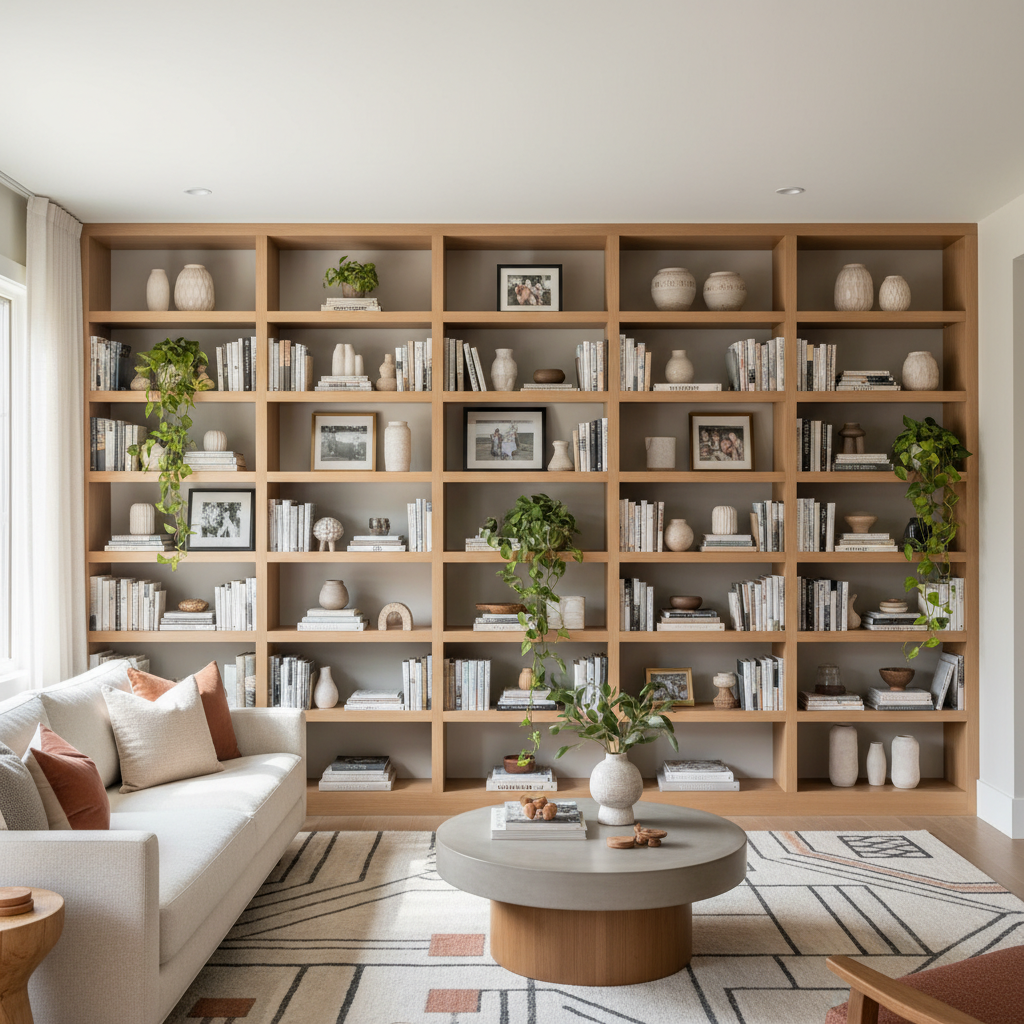
Start with a shelf “edit” (the part most people skip)
If you want shelves that look intentional, you need a quick filter for what shows and what hides. Otherwise every styling trick turns into clutter management.
- Pull everything off (or at least clear one shelf at a time) so you can see duplicates and awkward pieces.
- Separate into three piles: daily-use books, display-worthy books, and “store elsewhere.”
- Limit small items (candles, mini frames, knickknacks). Too many tiny objects create visual noise.
- Keep a margin for reality: if this is a working shelf, plan space for future books and mail, not just “perfect styling.”
According to The American Institute of Architects (AIA), good residential storage planning improves daily function and reduces visual clutter, which is exactly what a well-styled shelf is trying to accomplish in a small way.
Pick your shelf “job” before you style it
Most shelf frustration comes from mixing goals. Decide what each section is for, then style to match.
| Bookshelf goal | What it should look like | What to avoid |
|---|---|---|
| Library-first (reads matter) | Mostly books, a few anchors, consistent order | Too many objects blocking spines |
| Balanced (books + decor) | Grouped vignettes, varied heights, visible negative space | One item per inch “filling” the shelf |
| Display-first (statement shelf) | Fewer books, bigger objects, bolder art | Random small decor scattered everywhere |
| Family/utility (real life) | Closed baskets + curated top shelf, kid-friendly zones | Fragile pieces at grab height |
Once you decide the “job,” how to arrange bookshelf decoratively becomes a set of simple tradeoffs: more books means fewer objects, more objects means stronger spacing rules.
The 3-2-1 styling formula (simple, flexible, repeatable)
If you only remember one method, use this: each shelf works better when it has 3 book groupings, 2 decor moments, and 1 intentional empty zone. Adjust up or down for shelf length.
- 3 book groupings: one vertical row, one horizontal stack, one mixed cluster (or two vertical + one horizontal).
- 2 decor moments: a taller “anchor” and a smaller supporting piece.
- 1 empty zone: a clear patch that lets the eye rest (this is what makes it look expensive).
For the horizontal stack, keep it practical: 3–7 books usually reads as “styled,” while 1–2 looks accidental and 10+ looks like storage.
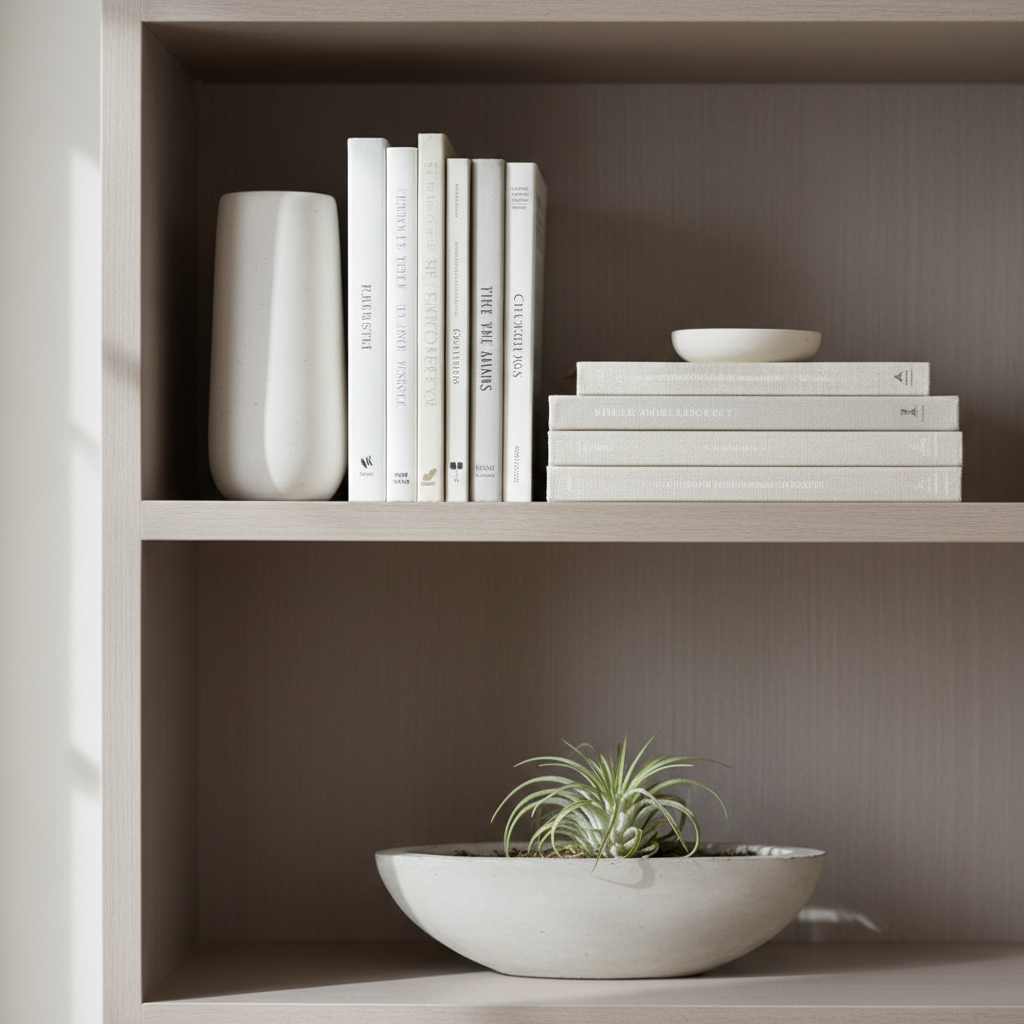
Make it look “designed” with height, depth, and layers
When people ask how to arrange bookshelf decoratively, they usually mean “how do I stop it looking flat.” Flat shelves are almost always missing one of these cues.
Height (tall + medium + low)
- Use one taller item per shelf area: vase, framed art, sculptural object, plant.
- Keep a medium item near it to create a step-down effect.
- Let the low items be books or a small tray.
Depth (pull some items forward)
- Slide a framed photo forward, keep books slightly behind.
- Place a small object on a short stack of books to create a “front layer.”
Layers (background + mid + front)
- Back: art leaning against the wall, or a larger frame.
- Mid: upright books, a vase, a box.
- Front: a small bowl, candle, or bookend.
According to The Getty (J. Paul Getty Museum), grouping objects thoughtfully and using visual hierarchy helps viewers understand what matters first, which is basically what you’re creating on a shelf.
Color and material: keep it cohesive without making it boring
You don’t need monochrome shelves, but you do need a plan. The easiest way is to limit your shelf to one dominant neutral, one wood tone, and one accent color.
- Dominant neutral: white, cream, black, warm gray.
- Wood tone: light oak, walnut, painted wood, whatever matches nearby furniture.
- Accent color: pick one that appears 3–5 times in small ways (spines, ceramics, art).
Materials do the heavy lifting when book spines are chaotic. A few repeat textures make the shelf feel intentional: ceramic + glass + woven basket is a classic trio for a reason.
Quick self-check: what’s making your shelf look “off”?
This checklist helps you diagnose the problem in two minutes, then choose the right fix instead of rearranging endlessly.
- It looks crowded: you have no empty zones, and too many small objects.
- It looks childish or random: too many novelty items, not enough repetition of color/material.
- It looks flat: everything is lined up at the same front edge, with no layered depth.
- It looks like a store: you have too many “display-only” pieces and not enough personal anchors.
- It looks unbalanced: all tall items sit on one side, or the heavy color clusters in one corner.
If you’re unsure, take a straight-on photo. What feels “fine in person” often shows the real spacing issues on camera.
Step-by-step: arrange one shelf in 15 minutes
This is the fast workflow that keeps you from overthinking. It works for bookcases, built-ins, and floating shelves.
- Place bookends or book blocks if you need them, then build one vertical book group.
- Add a horizontal stack nearby, then put one small object on top (a bowl, a candle, a small framed photo).
- Add one tall anchor (vase, plant, sculpture) on the opposite side to balance height.
- Create depth by pulling one object forward and pushing one element back.
- Stop early and leave a clean gap. If you keep filling, it usually gets worse, not better.
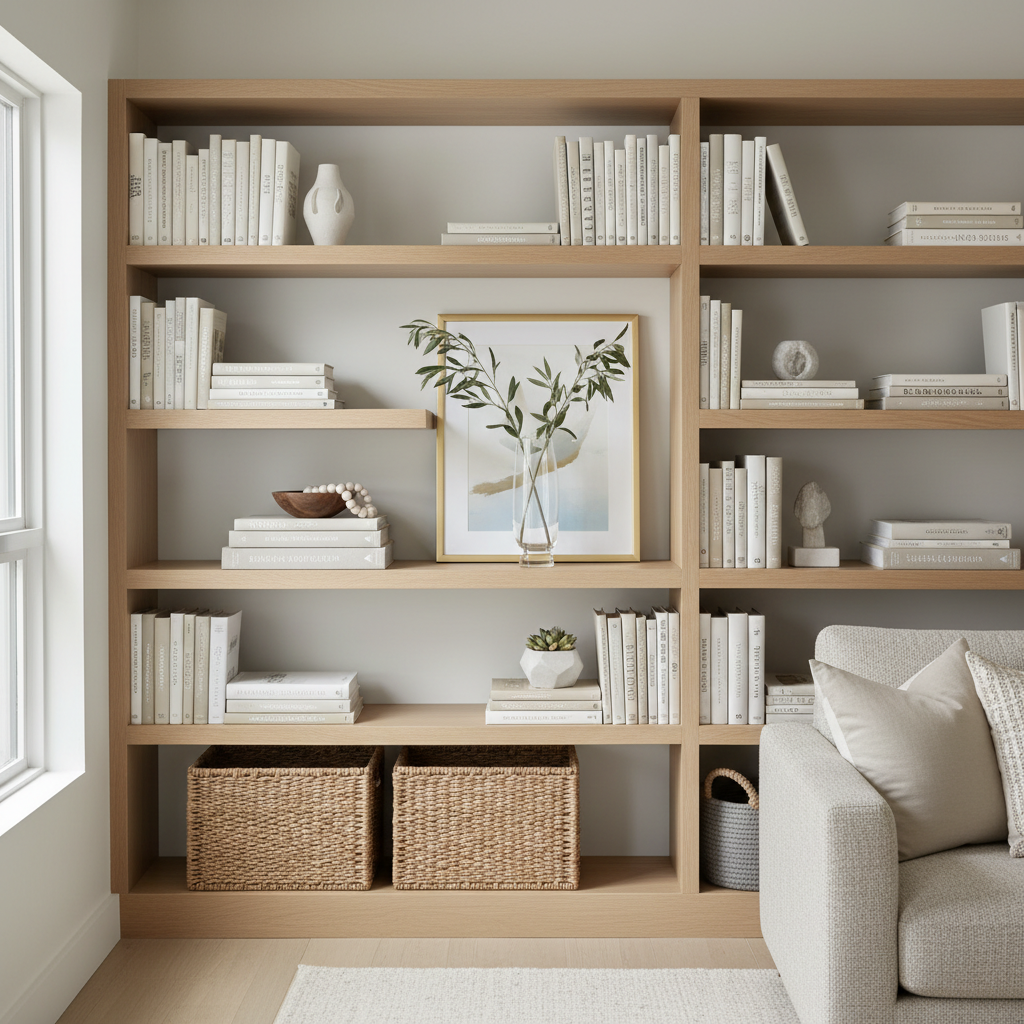
Common mistakes (and what to do instead)
- Mistake: arranging by rainbow color only. It can look trendy, but it often hides book variety and makes the shelf feel forced. Try color “clusters” instead of full-spectrum sorting.
- Mistake: filling every inch. Negative space is part of the design. If you need storage, add one closed basket or box rather than more tiny decor.
- Mistake: too many frames. One larger frame or piece of art per unit usually reads calmer than several small ones.
- Mistake: decor that blocks books you actually use. Put daily-use titles at easy reach, style higher shelves with more delicate pieces.
One more real-world tip: if the shelf sits near a TV, keep the most visually “busy” items away from that zone, otherwise the whole wall fights for attention.
When to bring in extra help (or just simplify)
If your shelves are part of a bigger remodel, or you’re dealing with built-ins that need lighting, anchoring, or custom spacing, it may be worth talking to a designer or contractor. For renters, a simpler approach usually wins: a few strong anchors, fewer small pieces, and better spacing.
If you have safety concerns, like tall cases in homes with kids or pets, consider professional advice on wall anchoring. According to the U.S. Consumer Product Safety Commission (CPSC), furniture tip-overs can be dangerous, and anchoring tall furniture is a common prevention step.
Conclusion: a decorative bookshelf is mostly editing and spacing
Once you decide what your shelf is for, the rest is structure: book groupings, a couple of anchors, and empty space that looks intentional. If you want an easy next move, style one shelf using the 3-2-1 formula, take a photo, then adjust just one thing at a time.
Key takeaways: edit first, vary height, add depth, repeat a few materials, and leave breathing room.
FAQ
- How do I arrange bookshelf decoratively if I have too many books?
Keep the shelf library-first: mostly vertical rows, then add one or two decor anchors per section. Rotate seasonal or less-used titles to another spot so the shelf can breathe. - Should books be vertical or horizontal for a styled look?
Both. Vertical rows feel tidy and functional, while a few horizontal stacks add structure for decor pieces to sit on. - What’s the easiest way to make shelves look less cluttered?
Remove small items and replace them with one closed basket or a larger object, then intentionally leave one open zone per shelf. - Is it okay to put fake plants on a bookshelf?
Yes, in many cases they read better than a struggling real plant. Choose one with believable texture and keep it dusted so it doesn’t look tired up close. - How many decor items should be on one shelf?
It depends on shelf length, but a good starting point is 2–4 objects plus books. If you’re past that and it feels busy, it usually is. - How do I style shelves when book spines are colorful and mismatched?
Use repetition elsewhere: matching baskets, similar ceramics, and a limited accent color. You can also turn a few books spine-in for calm, but don’t overdo it or it looks staged. - How do I decorate a bookshelf in a small apartment?
Prioritize function and hide mess: baskets on lower shelves, a curated middle shelf at eye level, and fewer small objects overall.
If you’re trying to make your shelves look pulled together fast, it helps to work from a simple “kit” you can reuse across rooms: a pair of bookends, one tall vase, a tray, and one or two baskets. That kind of repeatable setup often beats shopping for random little decor every time you restyle.